
Examine the history of nursing to see how the role has changed. From association with religious orders to Florence Nightingale professionalizing the field, see how nursing has continued to evolve and respond to new ideas to provide the best possible patient care.
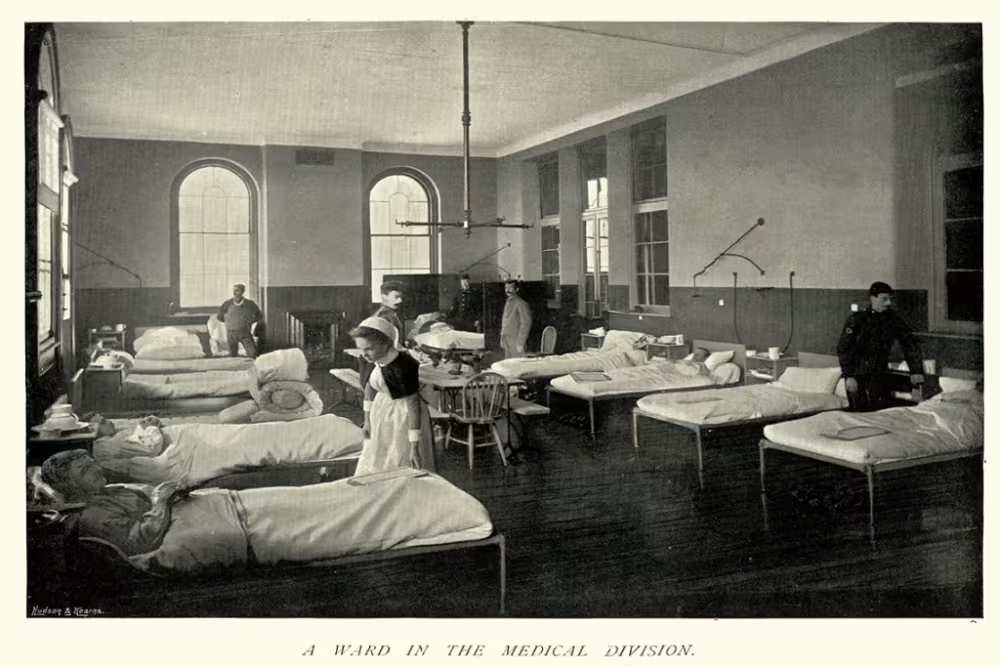
Around the world, people have provided nursing care to family members, neighbors, and others in their communities since ancient times. Nursing as an established profession, however, is a more recent development. The history of nursing can be fascinating to examine if you’re currently in nursing school or thinking about attending. By studying the origin of nursing, you can get a better sense of how far the profession has come.
Concordia University, St. Paul’s Accelerated Bachelor of Science in Nursing (ABSN) program strives to evolve and improve the nursing profession by graduating competent, compassionate students who are equipped to become nursing leaders. At CSP Global, you can enjoy a faster transition into nursing in as few as 16 months by leveraging your prior non-nursing education.
Before getting started in nursing school, explore the origin of nursing and the key moments that have shaped the profession throughout the centuries. Discover the background of the nurse as a formally trained clinician and learn how nursing history influences modern patient care.
The Background of Nursing Before Formal Healthcare
In early civilizations, people cared for loved ones who were ill, injured, aging, or giving birth as best they could. Our knowledge of this care is limited, however, due to gaps in the historical record. Caregiving came to be known as nursing care after the 13th century. During these early times, nursing was not considered a profession but an individual responsibility, typically carried out by families. Later, nursing care became associated with religious orders, which established early hospitals.
Midwives were among the earliest caregivers recognized for specialized knowledge. They supported women during pregnancy, labor, delivery, and the postpartum period. Practices differed across cultures but reflected the importance of caregiving to community well-being.
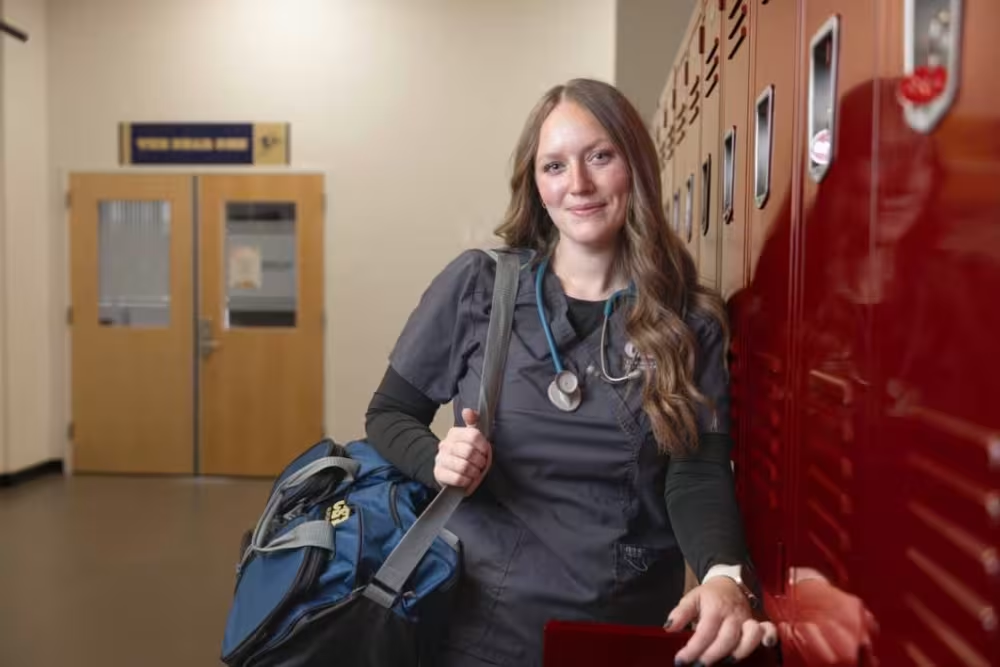
Explore the nursing pathways you could take to become a registered nurse.
The Origin of Nursing as a Recognized Profession
In the modern era, Florence Nightingale played an impactful role in transforming nursing care from an informal calling into a recognized profession. During the 1850s, she revolutionized standards of care and reduced patient mortality by introducing fundamental hygiene and sanitation practices. Later, she founded a nursing school to formally train nurses in theory and clinical skills.
Nursing History Timeline: Key Moments That Shaped the Profession

One way to examine nursing history is through the lens of key events and developments. Consider the following background of the nurse:
Circa 2000 BC to 500 AD: The earliest-known nursing school was established around this time in India. It accepted primarily male students. Meanwhile, in the ancient Roman Empire, male caregivers known as nosocomi nursed wounded soldiers back to health.
500 to 1300 AD: During the Middle Ages, nuns and monks, who had little to no formal training in nursing, often took on caregiving roles. Ordinary people nursed their loved ones throughout the various outbreaks of the Black Plague and when addressing more commonplace health issues.
1300s to 1600s: During the Renaissance, a focus on science, anatomy, and medicine influenced the informal nursing profession. Nursing care, however, was seen as low-status work, often performed by untrained volunteers. More hospitals were founded, but care was substandard; however, in 1633, St. Vincent de Paul cofounded the Daughters of Charity, an organization that continues to provide nursing care today.
1853-1856: The Crimean War helped lead to the modern nursing profession, as Florence Nightingale revolutionized nursing practice.
1872: The first nursing school in the U.S. opened its doors in 1872. A year later, the New England Hospital for Women and Children graduated America’s first professionally trained nurse: Linda Richards.
1896: The American Nurses Association (ANA) was founded.
1914 to 1945: During the First and Second World Wars, thousands of nurses served.
1980s: Nurse practitioners began to gain prescriptive authority.
1993: The National Institute of Nursing Research (NINR) was founded.
2020: Nurses served on the front lines during the COVID pandemic, helping to save patients despite limited personal protective equipment (PPE).
How Florence Nightingale Changed the History of the Nurse
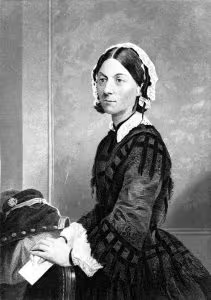
Florence Nightingale is one of the most influential figures in the history of nursing. By promoting organized care, professional training, sanitation, and data use, she helped nursing gain recognition as a skilled field. Her work showed that nurses could evaluate outcomes and advocate for patients.
Born in 1820, Nightingale showed an early interest in caring for others. As a young woman, she assisted people who were ill near her family’s home. She later pursued nursing preparation despite family resistance. At the time, paid nursing was viewed as low-status work and considered inappropriate for a woman of her social class.
In 1854, during the Crimean War, Nightingale led a group of nurses to a British military hospital in Scutari, in the Ottoman Empire. Reports described overcrowding, poor ventilation, inadequate waste removal, limited supplies, and high mortality rates. Nightingale believed these conditions contributed to preventable illness and death.
Nightingale and her team organized nursing work, obtained food and clean linens, and advocated for sanitation and ventilation. A British sanitary commission later made major environmental improvements. These reforms improved conditions and contributed to lower mortality. Nightingale also became known as “The Lady with the Lamp” for visiting patients at night.
Nightingale documented care and analyzed data about illness, death, and hospital conditions. She used statistics to explain patterns, helping to connect nursing with research and quality improvement. After returning to England, she established the Nightingale Training School and published Notes on Nursing, which discussed cleanliness, ventilation, nutrition, noise, and observation.
How Education Transformed Nursing History
Throughout much of human history, nursing care was provided informally by poorly trained or untrained caregivers. Nursing education has been instrumental in transforming the history of nursing. Throughout the history of nursing education, formal schooling has helped standardize evidence-based care and professional standards, thereby improving patient care and outcomes.
Florence Nightingale took a major step forward for the profession when she opened her nursing school in England. In the U.S. in the 1940s, the National League for Nursing Education (NLNE) began advocating for the integration of nursing into higher education. This led to the development of bachelor’s degree programs in nursing. Associate degree programs were introduced in the 1950s, followed by the first nurse practitioner program in 1965.
Learn how you can develop your personal philosophy of nursing.

The Growth of Nursing Specialties and Advanced Roles
Nursing specialties began to emerge as nursing became established as a professional field. Nurse anesthetists were the first specialists, emerging in the 1880s. As tuberculosis outbreaks spread in the early 1900s, public health nurses stepped up to combat them.
Additional specialties developed in response to population changes, research, and technology. Nurses now practice in critical care, emergency nursing, maternal and newborn care, mental health, oncology, pediatrics, public health, and more. Nurse informaticists combine nursing science with technology to improve documentation, workflows, decisions, and outcomes.
Advanced roles began to take root in the 1960s in response to physician shortages. These included nurse practitioners and clinical nurse specialists. Today, nurse anesthetists are also recognized as advanced practice clinicians.
The History of Nursing and Its Influence on Modern Patient Care
Societal shifts have often given rise to emerging healthcare needs, meaning that nursing history has influenced the modern patient care that nursing students are taught today. For example, increasing urbanization encouraged outbreaks of tuberculosis in the early 1900s, which in turn gave way to the emergence of public health nursing. Today, public health nurses continue to track disease outbreaks and educate the public about health issues.
Change can also bring about another type of transformation: expansion of the scope of practice. For example, a physician shortage in the U.S. in the 1960s prompted the development of recognized advanced practice roles, such as nurse practitioners. Later, in the 1980s, NPs began gaining prescriptive authority.

Build on the Legacy of Nursing at CSP Global
At Concordia University, St. Paul, we aim to graduate practice-ready nurse candidates prepared to become innovative nurse leaders who guide the nursing field into the future. At CSP Global, you could graduate with a BSN in as few as 16 months if you have a completed non-nursing bachelor’s degree or at least 54 non-nursing college credits. Benefit from immersive learning experiences and a supportive learning community in our ABSN program.
Request information and connect with an admissions advisor at CSP Global today to get started.